What is it meant to be?!
*Spoiler warning* This review will contain spoilers for Once Upon a Time In Hollywood. So, if you haven’t seen the movie yet and don’t want Tarantino’s artwork spoiled then save this and come back once you’ve seen it.
As I mentioned in the very first article ever posted on this blog, I had never seen a Quentin Tarantino movie. I hear those audible gasps – in fact I’ve been hearing them every time I’ve mentioned to someone that Once Upon a Time In Hollywood is my very first Tarantino film.
So, with expectations almost prohibitively high, I’m pleased to report that Once Upon a Time lived up to the billing in many ways. It’s a beautiful movie with amazing cinematography and some off-the-scale acting that should propel Leonardo DiCaprio, Brad Pitt and Margot Robbie into Oscar conversations.
But, I left the cinema wondering what this movie was actually meant to be.
Debriefing with my friend on the way home, we were both left scratching our heads as to how the plot unfurled in the final act. The movie was slow paced but seemingly with a purpose – an all encompassing payoff was bound to come in the closing scenes that would tie everything up in a satisfying finale.
It just didn’t happen. Instead we had a brutal if admittedly entertaining fight scene which served to underline some of the themes and tropes set up throughout the previous two and a half hours, but it didn’t match the scale of expectation that the film had built up.
I was convinced I was missing something. And, I was.
Entering the movie having only seen the trailer and having not followed the story of production, I was totally blind to the fact that in this story, Margot Robbie’s character Sharon Tate was based on a real 1960’s actress. In my ignorance, I had never heard of Tate’s tragic story and had no idea who ‘The Manson Family’ were.
A quick history lesson later and suddenly the movie makes sense and Tarantino’s subversion of expectations in the third act is the payoff that was missing. But, if you don’t have that knowledge and expectation going in, then what kind of plot does it leave?
An underwhelming one, which doesn’t really go anywhere. I’m sure I’m not the only one – in fact, I know I’m not the only one – who has watched Once Upon a Time without knowing the real world history of these characters.
With the knowledge I now have, I’d like to see the movie again to pick up on the contextual details that sailed way over my head. Maybe a second viewing will allow me to gain a new appreciation for the plot and the direction of the story that Tarantino is trying to tell.
The devil may not have barged into Rick Dalton’s living room during the final act but it was definitely in the detail in Once Upon a Time. There were countless innocuous moments – scenes, frames and lines – which ultimately turned into individual highlights within the film.
Details such as Cliff Booth’s dog food, (here’s me punting for a deep cut point). When we first see the trailer in which he lives, in stark contrast to Rick’s lifestyle, we see that Cliff has a near empty fridge, while his cupboards are stacked with dog food. Clearly, Cliff’s dog really is man’s best friend.
If not then, he certainly was when he leapt in to attack Tex and his ‘sisters’ when they broke into Rick’s house. The dog’s significance was essentially veiled until then, and his involvement in the final act makes the trailer scene one of substance.
And remember that seemingly cheap flamethrower scene in the first 10 minutes of the movie?That comes back to bare substance too. It’s these smart callbacks that are the highlights of an otherwise underwhelming final act.
Like these details, Tarantino doesn’t spell out the themes of his movie. They are nuanced in sub-plots and tangents. One of my favourite sequences is when Rick struggles on the set of his new movie and lets of steam in spectacular fashion in his room, with the scene juxtaposed alongside Sharon enjoying her new movie alongside happy moviegoers in a theatre.
The contrast here is stark and shows the highs and lows of Hollywood life. It’s not all sunshine and rainbows, despite what someone new to the game might think. As an allegory for life in general, it definitely stands up and the element of the film I enjoyed most was watching Rick Dalton combat his struggles.
This Hollywood actor, TV gunslinger, and general cool cat is vulnerable. He stutters when he’s nervous, faces an alcohol problem and he has serious doubts over where his career is heading and whether he can live up to the weight of expectation. DiCaprio knocks it out of the park with his portrayal.
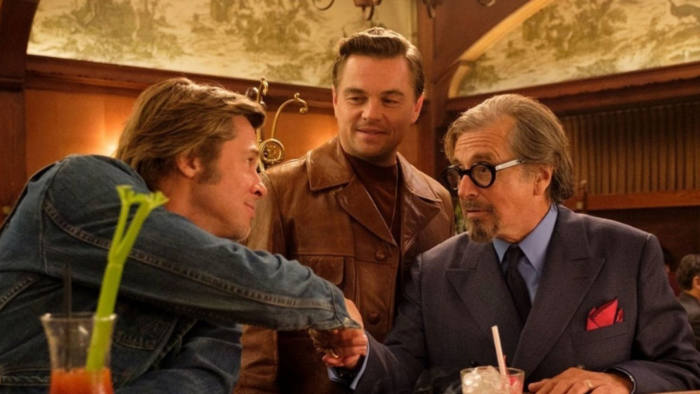
Somehow, Tarantino and the actors were able to make larger than life Hollywood figures relatable and that is no mean feat.
For the performances, the nuanced meaning behind the subplots and the smart callbacks dotted around the movie, Once Upon a Time somehow manages to compensate for having a weak plot and conclusion.
It’s like a two and three-quarter hour car journey where you get to your destination and it’s closed, National Lampoon style. But, you know what, I didn’t really care, because the journey was such a barrel of beautiful fun, that it was still worth the trip anyway.
 Talos More