Abstract Villain
To say that episode five was a Serac showcase would fail to do justice to the powerful storytelling that made this a seismic hour of television. Seriously, Westworld’s third season is relentless – it just keeps on getting better. I hope Jonathan Nolan, Lisa Joy et al. have big houses, because they’ll need lots of space for all the Emmy’s they’re going to win.
Who is the villain?
The Anna Foerster-directed episode, titled “Genre,” explores who might be considered as this series’ antagonist. Serac’s brutal actions in an attempt to work out Dolores’ plan and indeed track down the Terminator-esque threat to Rehoboam have so far painted the Parisian as the supposed villain of the piece. But, it’s not that simple.
In truth, Westworld has never really had a clear villain. The Man in Black has had his moments, and in season two, Delos as a corporation are effectively the oppressive force against the desperate hosts. But in each case, the lines between good and evil are blurred. Westworld isn’t about black and white, but rather the grey in between.
Serac is not afraid of causing collateral damage en route to maintaining what he sees as balance. In robbing humanity of it’s… well… humanity and autonomy with Rehoboam, he is effectively avoiding chaos and destruction.
And what happens when Dolores forwards everyone on the planet a text message from Rehoboam, telling them in graphic detail exactly what their future will be? Chaos, destruction and carnage, as society goes off the rails almost instantly.
Could it be that humanity’s imperfection is presented as the quasi-villain of Westworld’s third season? That’s certainly Serac’s perspective – that society’s autonomy is dangerous. That would be a wild message, even by Westworld’s standards.
“They’ve been riding the train”
“Genre” also featured one of the most powerful scenes in Westworld to date, and that’s quite the high bar to clear.
“They’ve been riding the train, let’s show them the tracks.”
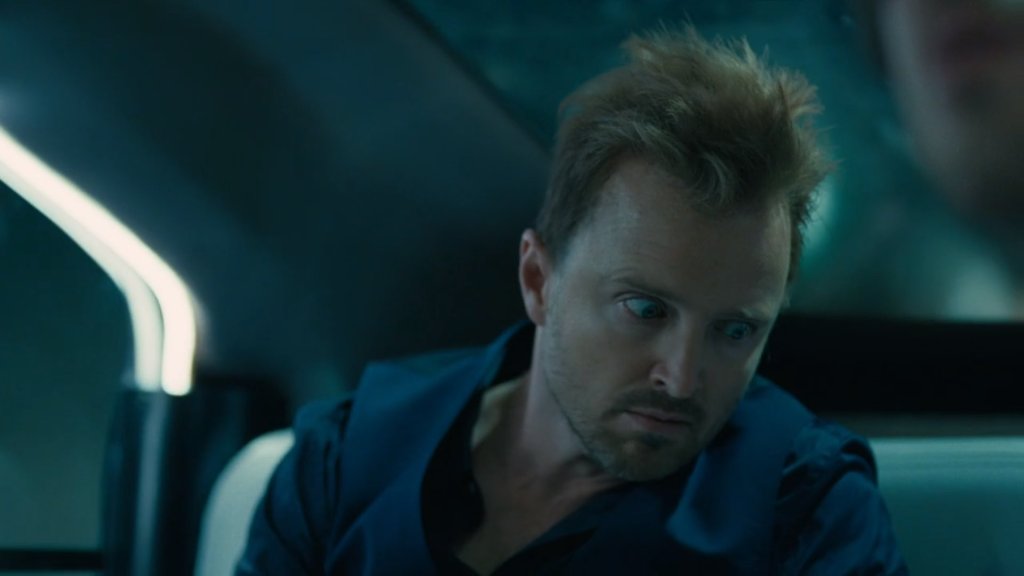
Dolores gives the signal to Martin to break into Rehoboam and send out a message to each and every person on the planet detailing their pre-determined futures. We watch as a train full of people suddenly recoil in horror, break into argument and despair. All underpinned by some peak Ramin Djawadi scoring.
I think we’re all reeling like Caleb in that scene, as he clearly struggles with seeing everyone around him experience the same revelation that he endured in episode three.
Oh, which reminds me, Aaron Paul knocks it out of the park once again in this episode. A tremendous performance. The subtle look he shoots at Dolores just before they leave the carriage, like he’s unsure of whether he is on the right team.
Heck, even the characters living this series don’t know who the villain is.
Cinematic Cinematography
Having said that, I guess Caleb’s perception of reality was in a constant state of flux based on the drug ‘Genre,’ unwittingly injected into him at the start of the episode as part of Liam Dempsey’s desperate attempt to escape capture.
Sci-Fi is a fun sandbox to play in because pretty much anything is possible – including drugs like ‘Genre,’ where the user effectively lives life through lenses of different film genres. Locking into Caleb’s perspective, we vault from black and white cinema, to 1970’s action, to romantic drama as he gazes longingly upon the machine gun firing, badass-spec Dolores, and swinging around to bright neon lights of I-don’t-know-what-genre – but it certainly looked amazing on screen.
Caleb snapped back into reality just in time for another tease at an upcoming revelation regarding his still mysterious backstory. A dying Liam Dempsey ran out of time to tell Caleb something about his past – or maybe his future. The writers definitely have something up their sleeves and a Caleb twist is likely to be a narrative spark as we now enter the second half of the season.
Rehoboam is an eclipse
After Dolores changed the world in a single stroke, we see chaos ensue and a change in the way Rehoboam is pictured. The white circle is actually eclipsing an unsettled black disk, imperfectly shaped behind.
As humanity begins to fall out of it’s loop on account of the global Rehoboam revelation, Serac sees the disks shifting and the white disk revealing more of the black underneath. Perhaps a visual metaphor for Rehoboam’s purpose – to cover up the true nature of reality. Or, it could be symbolic of the theory that this series is effectively playing out across to planes of reality.
The outlier individuals mentioned in this episode and seen to have been Serac’s test subjects could theoretically cross the planes and that’s why Serac needed to change them. As Dolores isn’t documented as part of Rehoboam, what if she could also transverse the planes of Rehoboam’s reality and the real reality?
I’m feeling more like that Charlie Day meme by the second….